Christmas Ornament 3D Baby Bird: Integrating High-Resolution PNG Assets into Holiday Production Workflows
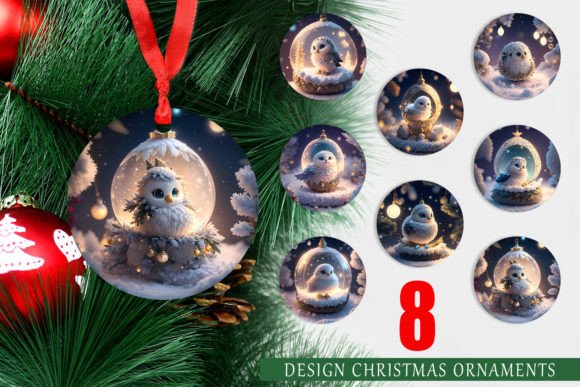
In the landscape of seasonal design and small business product development, efficiency often hinges on the quality and readiness of digital assets. The Christmas Ornament 3D Baby Bird collection represents a specific category of production-ready graphics designed to bridge the gap between digital creativity and physical manufacturing. This set of eight circular decorative designs is not merely a collection of festive imagery; it is a standardized resource engineered for print workflows. With specifications fixed at 5x5 inches and 1500x1500 pixels at 300 DPI, these files eliminate the guesswork typically associated with resizing and resolution management. For professionals, educators, and hobbyists alike, understanding how to leverage these high-resolution PNGs within a broader operational context ensures that the final output—whether a commercial product or a personal keepsake—maintains professional integrity from screen to substrate.
Technical Specifications and Workflow Compatibility
Before initiating any print project, verifying asset compatibility is the first critical step in quality control. The Christmas Ornament 3D Baby Bird files are pre-configured to industry standards that align with most consumer and prosumer printing equipment. The 300 DPI resolution is the baseline requirement for crisp, artifact-free printing on glossy paper, cardstock, vinyl, or ceramic transfer media. At 1500x1500 pixels, each file provides sufficient pixel density for a 5-inch physical diameter without requiring upscaling algorithms that can introduce blur or noise.
This standardization simplifies the pre-production phase. When integrating these assets into software like Adobe Illustrator, Canva, Affinity Designer, or specialized RIP (Raster Image Processor) software for sublimation, users can place the files at 100% scale with confidence. This removes the need for iterative test prints to check clarity, saving both time and material costs. For entrepreneurs managing inventory for holiday markets, this predictability allows for accurate batching. You can calculate ink usage, paper waste, and production time per unit because the variable of image quality has been stabilized by the asset provider.
File Management and Asset Organization
Efficient creative work requires organized digital infrastructure. Because this set contains eight distinct variations of the 3D baby bird motif, establishing a logical file naming convention upon download prevents workflow bottlenecks later. Rather than keeping generic filenames, consider renaming assets based on their intended application or visual characteristic, such as BabyBird_Blue_Circle_5in.png or Ornament_GoldAccent_PrintReady.png.
For users operating across multiple platforms or collaborating with team members, storing these high-resolution PNGs in a cloud-synced folder structure ensures version control. Since PNGs support transparency, they are particularly versatile for layering. However, this also means file sizes can be significant. Maintaining a dedicated "Print Master" folder separate from "Web/Social" derivatives ensures that the original 300 DPI source files are never accidentally overwritten by compressed versions intended for Instagram or Etsy listings. This separation of assets is a fundamental best practice in digital asset management that protects the long-term utility of your design library.
Pre-Production Planning and Design Integration
The circular format of the Christmas Ornament 3D Baby Bird designs dictates specific layout considerations. In the planning phase, these assets serve as anchor points for composite designs. Because the artwork features a faux-3D aesthetic, it pairs best with backgrounds and typography that respect its lighting and depth cues. Placing flat, two-dimensional text directly behind a shaded 3D bird can create visual dissonance. Instead, use these ornaments as foreground elements or frame them with complementary shadows to ground them in the composition.
For marketers and content creators, these assets function effectively in pre-launch campaigns. Before committing to a full print run, use the PNGs to create realistic digital mockups. The high resolution allows for detailed zooming in product listings, giving customers confidence in the print quality they will receive. This stage is also ideal for A/B testing different ornament designs to gauge audience preference. By utilizing the digital files in social media polls or email newsletters, you can validate demand for specific bird variations before allocating resources to mass production. This data-driven approach minimizes risk and aligns inventory with actual market interest.
Material Selection and Color Profiling
The transition from RGB screen display to CMYK or dye-sublimation output requires careful material selection. While the Christmas Ornament 3D Baby Bird files are optimized for print, the final appearance depends heavily on the substrate. Glossy photo paper and white ceramic blanks will render the 3D shading and highlights most accurately, preserving the intended dimensionality. Matte papers or uncoated woods may absorb ink differently, potentially flattening the 3D effect.
Professionals should always perform a soft proof using the ICC profile specific to their printer and paper combination. Even with perfect 300 DPI source files, color shifts can occur. Testing one ornament from the set on your chosen material allows you to adjust saturation or contrast curves globally before printing the entire set of eight. This calibration step is non-negotiable for maintaining consistency across a product line. If you are outsourcing production, providing the print shop with the exact specifications of these files ensures they apply the correct color management settings, reducing the likelihood of rejected batches.
Execution Strategies for Various Use Cases
The versatility of this PNG set extends beyond traditional ornament manufacturing. Educators and community organizers can integrate these designs into interactive learning or engagement activities. For example, the 5x5 inch size is ideal for classroom craft projects where students assemble decorations. The high resolution ensures that even when printed on standard office laser printers, the details remain sharp enough for coloring or decoupage. In this context, the asset serves as a reliable template that reduces preparation time for instructors while delivering a polished result for participants.
For small business owners focusing on personalized gifts, these circular designs act as modular components. They can be combined with custom text fields, family names, or year markers to create bespoke products without redesigning the core illustration. The transparency of the PNG format allows for seamless integration over textured backgrounds or colored cardstock. When executing these custom orders, create master templates in your design software with locked layers for the bird ornament and editable layers for the personalization. This templating system streamlines the fulfillment process, allowing you to swap out text while keeping the high-quality visual element constant.
- Sublimation Printing: Mirror the image before printing and ensure heat press temperature aligns with blank specifications to prevent ghosting of the fine 3D details.
- Paper Crafts: Use heavy-weight cardstock (80lb+) to support the visual weight of the 3D design; consider adding a physical gloss varnish to enhance the digital shading.
- Digital Products: Bundle the PNGs with a PDF instruction guide for DIY customers, adding value through education rather than just selling the raw file.
- Mixed Media: Combine the printed ornament with physical embellishments like ribbon or glitter, using the digital 3D shading as a guide for where to apply physical highlights.
Post-Production Quality Control and Archiving
After printing, a systematic quality check ensures the Christmas Ornament 3D Baby Bird assets have translated correctly to the physical medium. Inspect the edges of the circular design for jagged pixels or color bleeding, which can indicate printer head misalignment or incorrect scaling. Verify that the 3D shading retains its gradient smoothness; banding in the gradients often suggests the printer was set to draft mode or the file was inadvertently downscaled during export.
Long-term value extraction from this design set involves proper archiving and repurposing. Once the holiday season concludes, do not delete the project files. Archive the master documents alongside the original PNGs. These assets can be repurposed for future years, adapted for spring themes by changing background colors, or used in retrospective portfolio pieces. For digital sellers, track which of the eight designs performed best and use that insight to inform future asset acquisitions or custom illustrations. Treating this purchase as a data point in your broader creative strategy transforms a simple decoration file into a strategic business asset.
Ultimately, the successful implementation of printable design sets relies on respecting the technical parameters and integrating them thoughtfully into existing workflows. The Christmas Ornament 3D Baby Bird collection offers a balance of aesthetic appeal and technical precision that supports both creative expression and operational efficiency. By approaching these files with a process-oriented mindset—focusing on preparation, material compatibility, and systematic execution—users can elevate their holiday projects from casual crafts to professional-grade productions. Whether you are stocking an Etsy shop, preparing a classroom activity, or creating heirloom decorations for your own tree, the discipline applied to handling these assets determines the quality of the final outcome.